We share here a selection of inspiring paintings related to solar and lunar eclipses in history… Actually, arts and sciences can easily relate to each other as we can see from these wonderful masterpieces… We know that the science of Astronomy is very visual, so paintings can help us understand many hidden details of how humanity reacted to solar and lunar eclipses throughout history…
We show you here how several painters related eclipses to important historical events… And there are some masterpieces that are pure art related to eclipses… There are many examples here, and we hope that educators, students and the general public will find our selection interesting and inspiring leading them to share these pictures with friends and other people interested in arts, eclipses, history…
Ancient Eclipse Paintings
Years: 3.500 BC – 476 CE
According to some researchers, eclipses were not generally depicted in paintings from the early ages because solar eclipses were seen as bad omens, and the sun was a god with monsters/demons to fight, and Ancient civilizations feared the disappearance of the sun because the existence of their agricultural societies depended on sunlight…
That is why there are not so many art pieces from that time…
We show you here a selection of Ancient eclipse paintings/depictions… Let’s get started with our first example…
Depiction of a solar eclipse in 1143 BCE in a tomb for Pharaohs Ramesses V and VI, perhaps the oldest preserved visual representation of an eclipse worldwide.
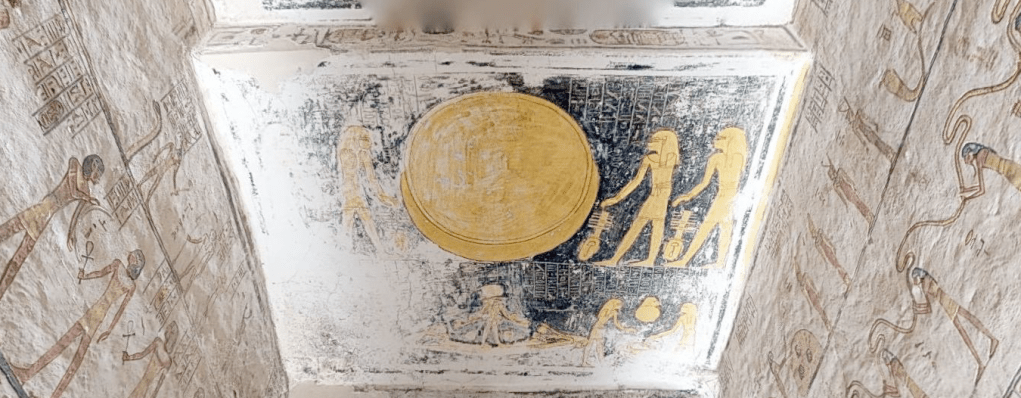
A remarkable part of the ceiling mural in corridor G to the burial chamber of Tomb KV 9 for Pharaohs Ramesses V and VI can be interpreted as depicting a solar eclipse in 1143 BCE, which reached 80% totality in the Theben region and full totality further south in the Syene (Assuan) region of Ancient Egypt. This mural agrees perfectly with the book Amduat on the walls of corridor G whose 12th hour it replaces. In the 20th dynasty, a solar eclipse was interpretable as a momentary unification of Ra (the sun) and Osiris (the moon). If Klaus Hentschel’s interpretation is correct, this mural might be the oldest preserved visual representation of an eclipse worldwide. Source: https://www.arcjournals.org/pdfs/ijhcs/v7-i2/2.pdf
In Ancient China, it was believed that there was a big dragon or dog in the sky that swallowed the sun and moon during solar or lunar eclipses… In the next photograph, we see a picture that represents such a celestial monster…
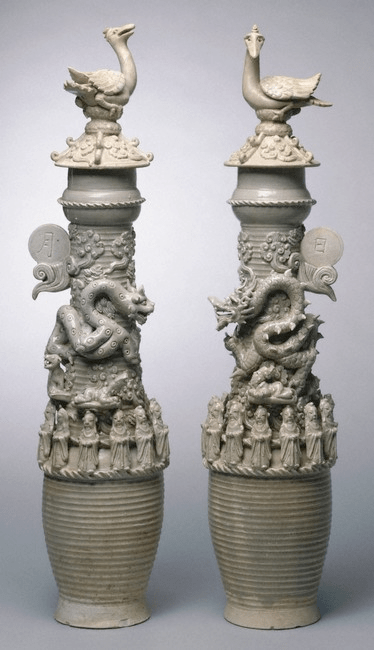
Southern Song dynasty, 1127–1279, Yuan dynasty, 1271–1368, Pair of “Sun Moon” Funerary Vases, 13th–14th centuries Porcelain with blue-green glaze and appliqué designs .1 a-b (sun): h. 79.0 cm., diam. 18.1 cm. (31 1/8 x 7 1/8 in.) .2 a-b (moon): h. 78.8 cm., diam. 18.2 cm. (31 x 7 3/16 in.) Princeton University Art Museum. Gift of Nelson Chang, Class of 1974, on the occasion of the 25th Reunion of the Class of 1974.
Source: https://artmuseum.princeton.edu/collections/objects/37378
Medieval Eclipse Paintings
Years: 476 CE – 1453 CE
In the next painting, you can see soldiers and the sun at the back, obscured by some clouds… It would be nice to see this original painting in an art gallery, or while you listen to songs in our section Eclipses and Music, such as Total Eclipse of the Heart or Don’t let the sun go down on me…
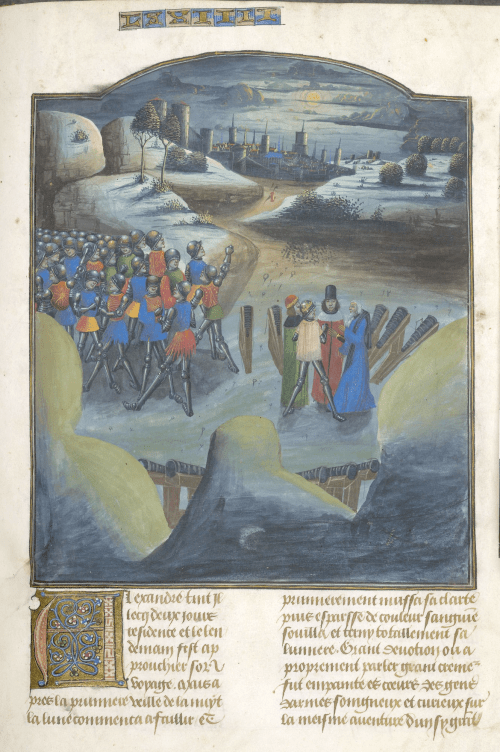
Alexander the Great consulting his astrologers about a solar eclipse after the Battle of Arbela: British Library Burney MS 169, f. 69r. Public domain image. Source: https://blogs.bl.uk/digitisedmanuscripts/2017/08/total-eclipse-of-the-sun.html
Please check our section concerning Eclipses and Music… There are many nice inspiring songs related to eclipses and Astronomy…
Let’s see some examples of associations of eclipses and biblical events…
Christian-related eclipse associations:
- In the Old Testament: The text about Plagues of Egypt, describes a darkness lasting three days.
- Crucifixion of Christ: The Gospel of St. Matthew tells that darkness lasting three hours accompanied by earthquakes and the raising of the dead, followed the Crucifixion of Christ. These apocalyptic associations were supported by other medieval accounts.
- Apocalypse: The Middle English copy of The Fifteen Signs before Doomsday found in British Library Harley MS 913, tells that the first sign of the approaching Apocalypse is that the ‘Sun will give no light and will be cast down to Earth – while you now see it [the Sun] as pleasing and bright, it will become as black as coal.’
For hundreds of years, artists have incorporated the amazing sight eclipses in their paintings…
This 14th-century fresco by Taddeo Gaddi, found in the Basilica of Santa Croce in Florence, depicts an angel announcing the birth of the baby Jesus to shepherds during an eclipse…

Annunciation to the Shepherds. Credit: Taddeo Gaddi. Public Domain. Source: https://www.livescience.com/59890-solar-eclipses-in-fine-art-images.html
A letter attributed to Gaddi, written between 1338 and 1348, suggests that he suffered serious eye damage from looking directly at the sun during an eclipse…
This fresco in the Padua Baptistery — a religious building near the Piazza del Duomo cathedral in Padua, Italy, and dedicated to St. John the Baptist — shows the crucifixion of Jesus during an eclipse, painted by Giusto de Menabuoi, circa 1378. Crowds of onlookers stand around and the Virgin Mary has fainted.
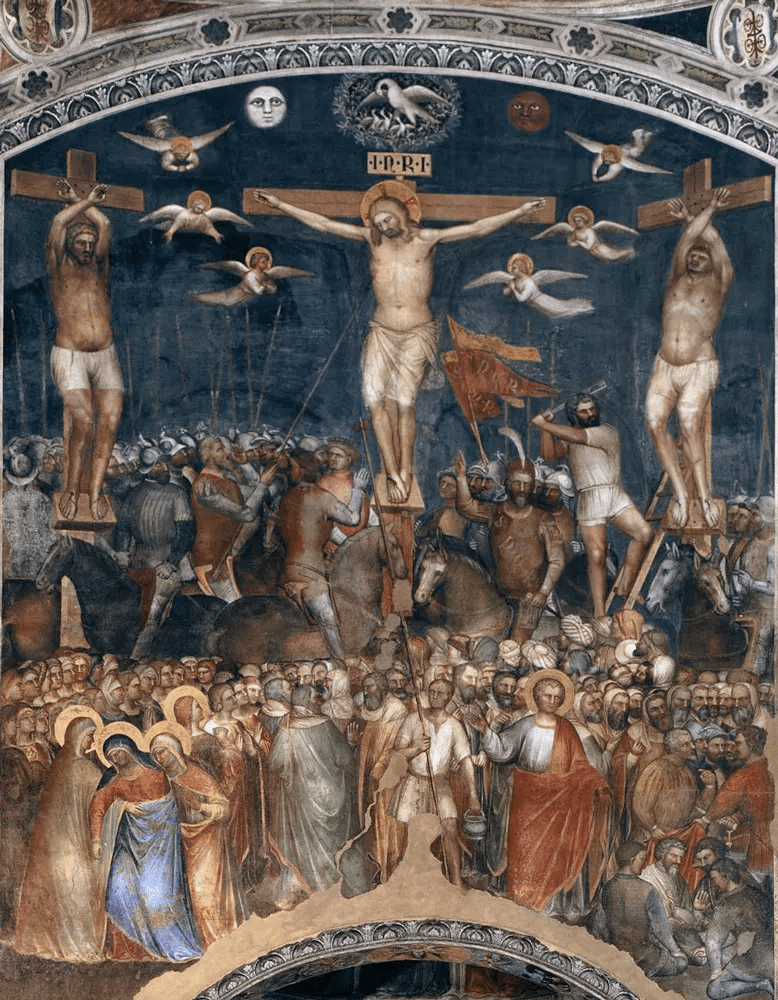
Crucifixion. Credit: Giusto de Menabuoi. Public Domain. Source: https://www.livescience.com/59890-solar-eclipses-in-fine-art-images.html
According to the tradition in crucifixion scenes from this era, the sun is to the left of the Christ figure, while the moon is to the right. Menabuoi depicted the moon with “the red glow of a lunar eclipse,” while the sun appears “cool and pale.”
In the next figure, you can see an image of what is probably a total solar eclipse etched in a stone a long time ago…
Ancient rock art in Chaco Canyon may depict a total solar eclipse in 1097. Please visit: https://science.nasa.gov/wp-content/uploads/2024/01/predict-the-corona-activities.pdf
Modern Eclipse Paintings
Years: 1453 CE – 1789 CE
Total solar eclipses are cyclical phenomena. In contrast to popular belief, they are not so rare and happen every 18 months or so somewhere in the world…
In Renaissance art, the eclipse was used in Crucifixion scenes to symbolize the great darkness and anguish as described in the Gospel of Luke. The eclipse is here seen on the right panel of the triptych…

Credit: Peter Paul Rubens, The Elevation of the Cross, Oil on Canvas, 462x640cm, 1610 (wikiart.com). Public Domain. Source: https://artmejo.com/eclipses-throughout-art-history/
The picture on the link below shows Rahula, an Indian demigod related to eclipses… Here is an explanation as found on Princeton University website…
“Rahula, the Tibetan protector deity, is based on the Indian deity Rahula, an ancient god, a demigod of the cosmos, related to the eclipse of the sun, moon, and other planets. In the ancient tradition of Tibetan Buddhism, Rahula became popular as a protector of the “revealed treasure” teachings. In Buddhist depictions he is portrayed with the lower body of a coiled serpent spirit and an upper body with four arms and nine heads, adorned with a thousand eyes. In the middle of the stomach is one large, wrathful face. The face in the stomach is actually the face and head of Rahula. The nine stacked heads depicted above are the nine planets that Rahula has eclipsed—or, rather literally, swallowed—and they now symbolically appear on top of his own face and insatiable mouth. At the crown of the stack of heads is the head of a black raven.”
See: http://www.himalayanart.org/search/set.cfm?setID=493
Figure here – https://artmuseum.princeton.edu/transient-effects/eclipses-art/rahula
In the next painting we can see St. Benedict experiencing a vision during a total solar eclipse, likely inspired by the eclipse that took place May 22, 1724, the Princeton Art Museum reports…

Vision of St. Benedict by Cosmas Damian, 1735. Credit: Jay Pasachoff/NASA. Photo by Achim Bunz. Source: Benedictine Abbey Weltenburg.
The oil painting above also shows the solar corona — the aura of plasma around the sun — and the so-called “diamond ring effect,” when light around the rim of the sun is fragmented by the moon’s rocky landscape, according to NASA…
Eclipse depictions became more realistic during the Renaissance, known for its convergence of art and science. Around 1518, Raphael and his workshop created this fresco – Isaac and Rebecca Spied Upon by Abimelech. Located in the Vatican Palace, it shows a solar eclipse…

Isaac and Rebecca Spied Upon by Abimelech, 1518-1519. By Raphael. Public Domain. Source: https://www.smithsonianmag.com/arts-culture/long-history-of-art-inspired-by-solar-eclipses-180984072/
In this Fresco, Raphael and members of his workshop depicted the aura around the sun as an angelic halo. The painting refers to a biblical interpretation of Genesis 26:8 where Isaac refers to his wife Rebecca as his sister to avoid being killed because of her beauty. Isaac and Rebecca hide away under the eyes of Abimelech, the king of the Philistines…
Eclipses Paintings in the Contemporary Age
Years: 1789 CE – Present
This painting depicts hurricane-battered Prince Edward Island in Canada coupled with an abstract depiction of a solar eclipse…
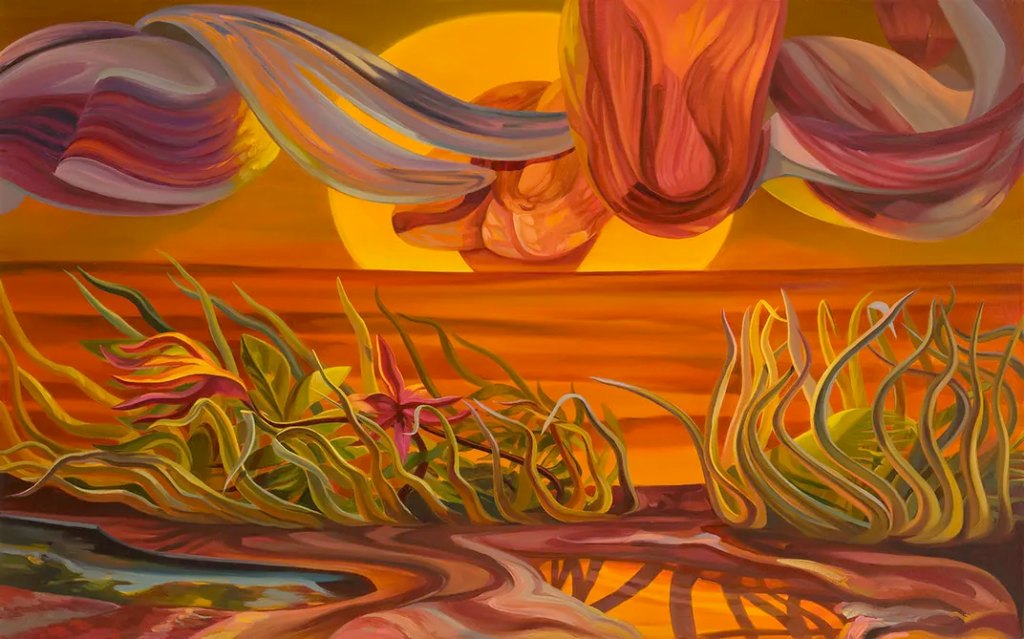
Rachel MacFarlane, The Event, 2024. Oil on canvas. Courtesy of Rachel MacFarlane and Hollis Taggart. @ Rachel Macfarlane 2024. Source: https://www.smithsonianmag.com/arts-culture/long-history-of-art-inspired-by-solar-eclipses-180984072/
The next image shows the beautiful corona… A nice drawing of the outer atmosphere of the sun…
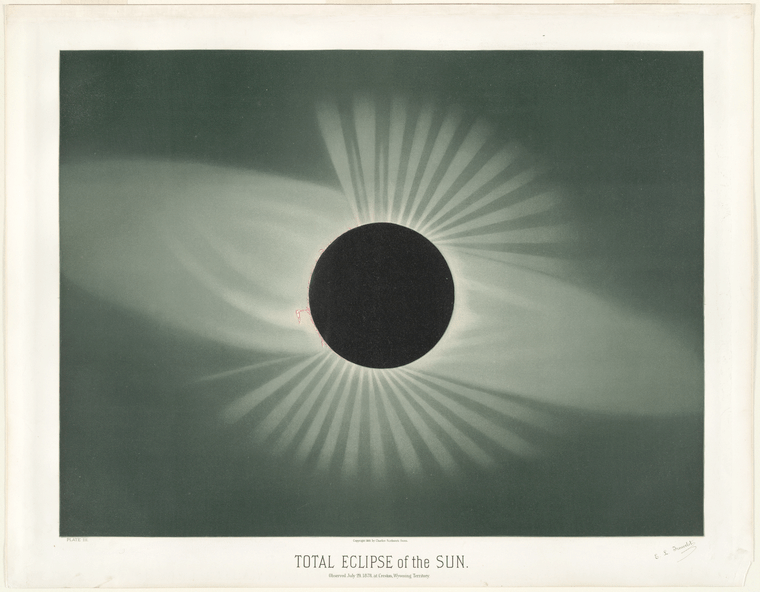
Rare Book Division, The New York Public Library. “Total eclipse of the sun” The New York Public Library Digital Collections. 1881 – 1882. Public domain. https://digitalcollections.nypl.org/items/510d47dd-e81f-a3d9-e040-e00a18064a99
This artistic video below shows that through different historical ages, science dialogues with the arts, and artists try to capture the meaning and human reactions to the awe-inspiring phenomenon which is a solar eclipse…
Indeed, eclipses of the moon are also beautiful, but solar eclipses when they are total, can turn day into night for a few minutes… Animals become afraid and change their behavior… Many people, both scientists and Astronomy lovers, various types of eclipse chasers travel faraway and fill hotels to observe solar eclipses… The same does not happen with lunar eclipses that are much more common…
As we mentioned before, there are many mentions of solar eclipses in the Christian Bible… It shows that solar eclipses are everywhere and no one ignores them… Even the privileged men who produced the Bible inspired by the Holy Spirit dealt with and described the reality of solar eclipses as signs of God to important events in human history, such as Jesus’ crucifixion and the Apocalypse…
As we also mentioned on this website, in the beginning of the Third Millenium people in different parts of the world were expecting the end of times (Apocalypse), and associated that with the occurrence of solar eclipses…
Luckily for us the end of times has not yet come, and we can still observe and admire magnificent events such as the great American eclipses of 2023 and 2024… Very recent in our time…
Rivera painted this Cubist-inspired portrait of his friend, Spanish poet Ramon Gomez de la Serna in 1915 with a full solar eclipse replacing the man’s right eye…
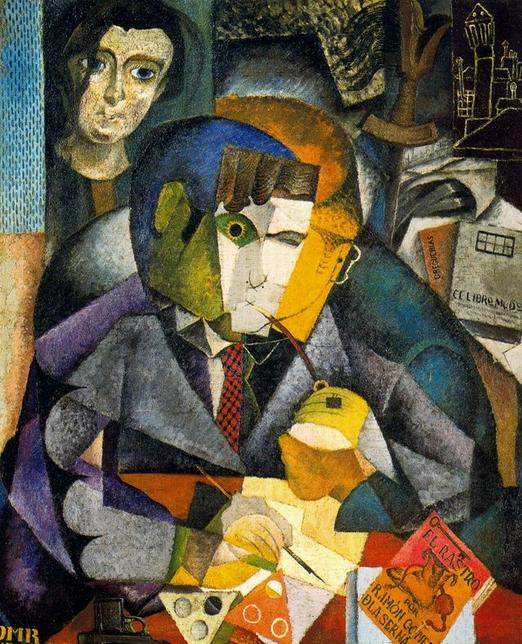
Diego Rivera, Portrait of Ramon Gomez de la Serna, Oil on Canvas, 109.6×90.2cm, 1915, Mexican. Public Domain US. Source: https://artmejo.com/eclipses-throughout-art-history/
The next image shows eclipse watchers in Paris at the beginning of the last century…
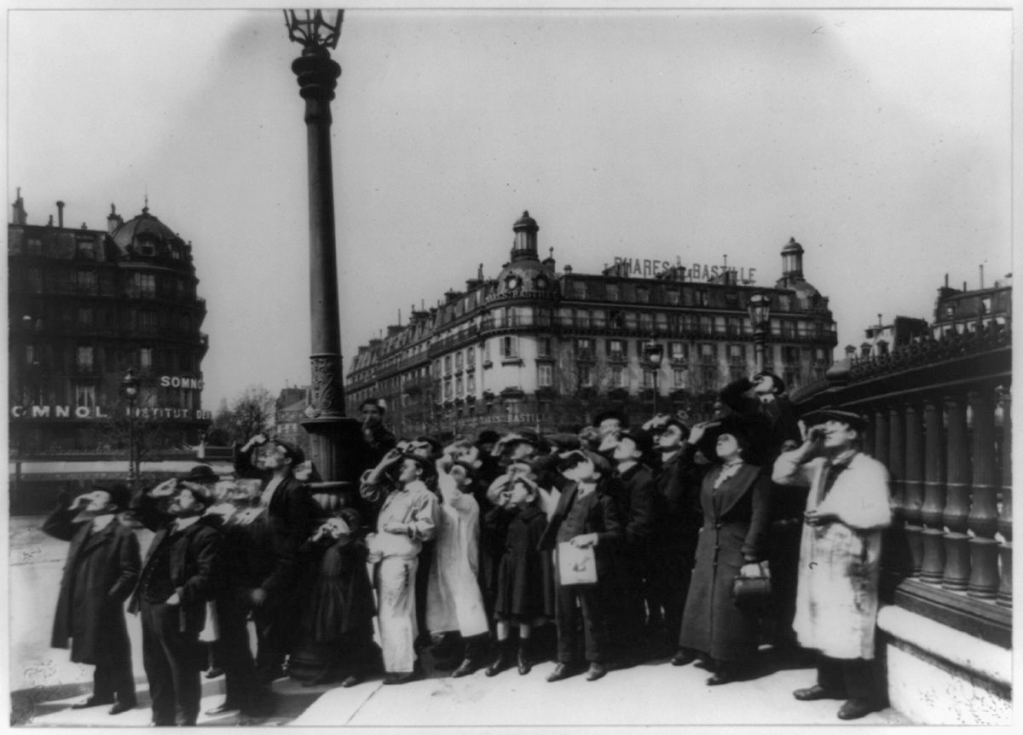
Eugène Atget’s photo of eclipse watchers in Paris, 1911. Library of Congress/ LC-USZ62-99200
And in the next image, we can see children in a school observing a solar eclipse…
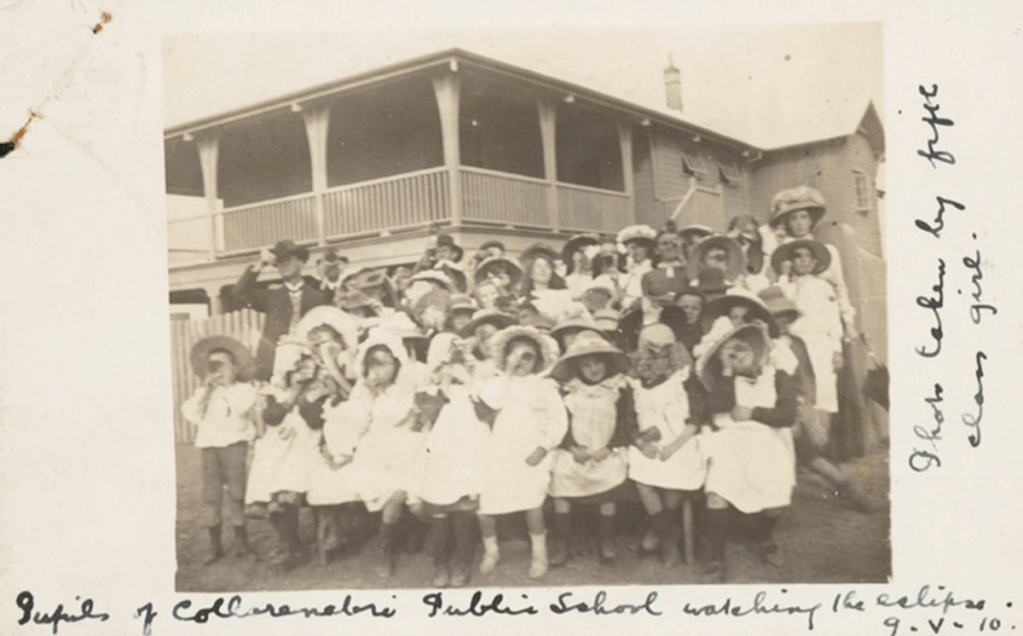
Children from the Collarenebri Public School watch the eclipse over New South Wales, Australia, 1910. NSW State Archives & Records/ Public Domain
Politically charged Dadaist-Surrealist painting by German artist Grosz points towards debates and questions related to the American financial support of Germany after World War I through the Dawes plan. The lunar eclipse in the top left corner is stamped with the U.S. dollar sign…
Figure here (6. George Grosz) – https://artmejo.com/eclipses-throughout-art-history/
In the next astonishing painting, we notice the misty veil of atmosphere that gives way to the depth of space, and the way the enormous clouds are slowly rolling through the sky… The colors of the sky are reflected in the hills below, giving a dreamy feeling to the scene…
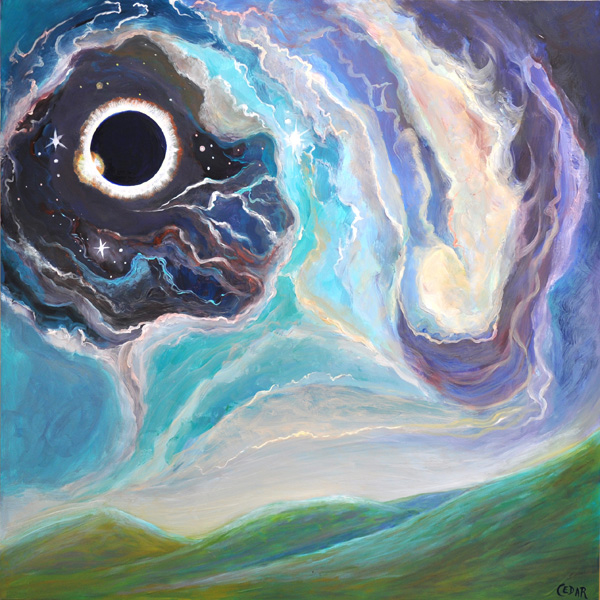
Eclipse in an Ancient Land. 24″ x 24″, Oil on Wood, © 2013 Cedar Lee. Source: ArtByCedar.com
In the next photo you can see the diamond ring, one of the most beautiful spectacles of the eclipsed sun…
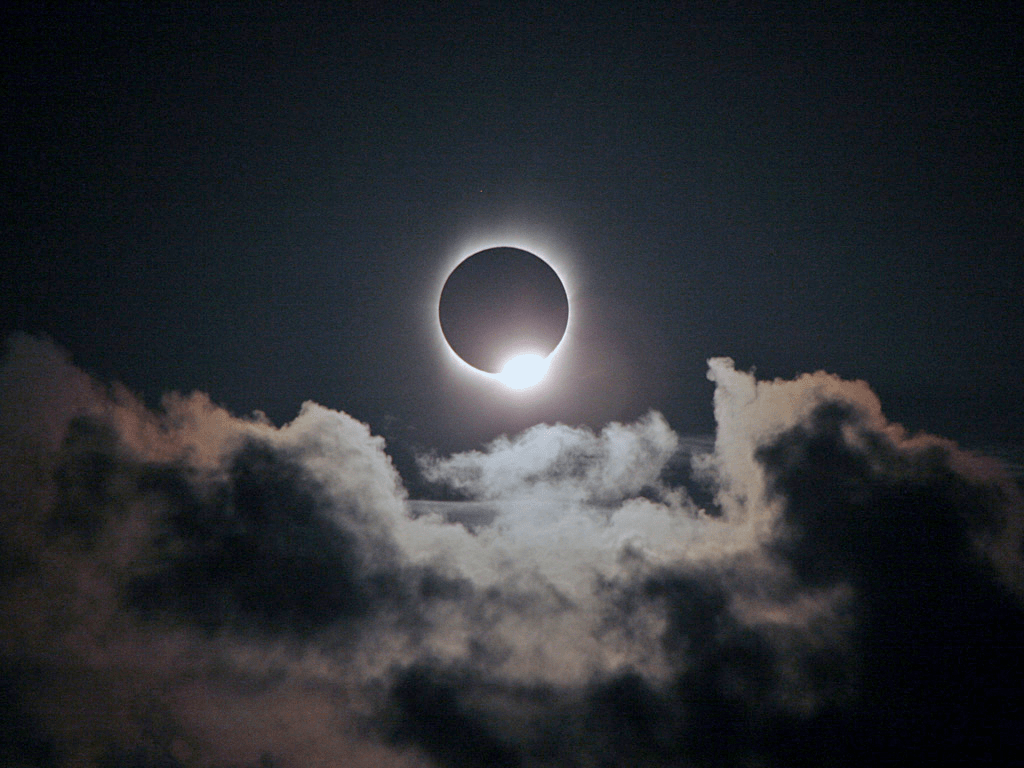
Credit: Rick Fienberg. American Astronomical Society. Source: https://eclipse.aas.org/sites/eclipse.aas.org/files/DiamondRing2009-RickFienberg.jpg
Howard Butler was scheduled to travel to Ensenada, Baja California (Mexico), with the Lick Observatory Group to see the eclipse of 1923. At the last minute, he caught a cold and did not want to travel to Baja and “rough it,” so he stayed in his summer home in Santa Barbara and traveled to nearby Lompoc to see the eclipse…
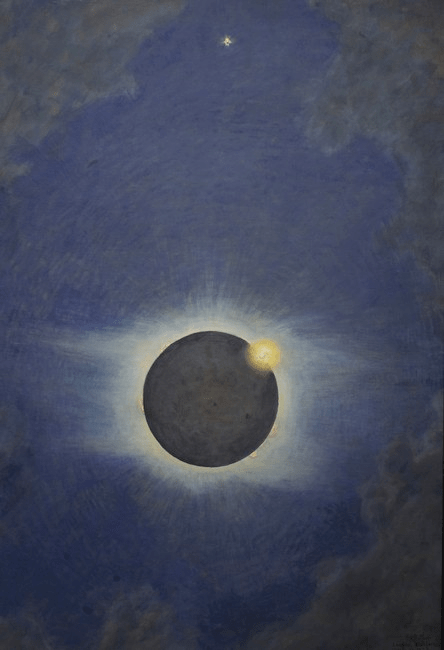
Howard Russell Butler (1856–1934; born New York City, NY; died Princeton, NJ), Solar Eclipse, Lompoc 1923, 1923. Oil on canvas, 122.5 × 82.5 cm. Princeton University, gift of H. Russell Butler Jr. Courtesy of Princeton University Art Museum. Source: https://artmuseum.princeton.edu/transient-effects/painter-sun/eclipse-paintings-howard-russell-butler/butlers-eclipse-paintings
Butler was fortunate; the astronomers in Baja and San Diego were “clouded out,” whereas he saw the eclipse through scattered clouds in Lompoc. Butler prepared an “observing chair” from which to watch the eclipse, and had this with him in Lompoc. Although alone, he was well prepared to paint the eclipse.
“Who is not interested in the total eclipse of the sun? He who has once seen such an eclipse can never forget it: the slow but graduate obscuration of the sun, the darkness covering the face of the Earth even at noontime, and the glorious sight that meets the eye during the few short minutes of totality.”
(Samuel Alfred Mitchell, director, Leander McCormick Observatory, University of Virginia, who led the U.S. Naval Observatory Eclipse Expeditions of 1918, which Howard Russell Butler accompanied.)
A tale tells that the Ancient Chinese believed that solar and lunar eclipses were produced by a hungry dog named Tiangou or Tian Gou (“heavenly dog”), trying to eat the sun or moon. Luckily, Tiangou was always stopped by the god of childbirth, Chang Xian, an expert archer…
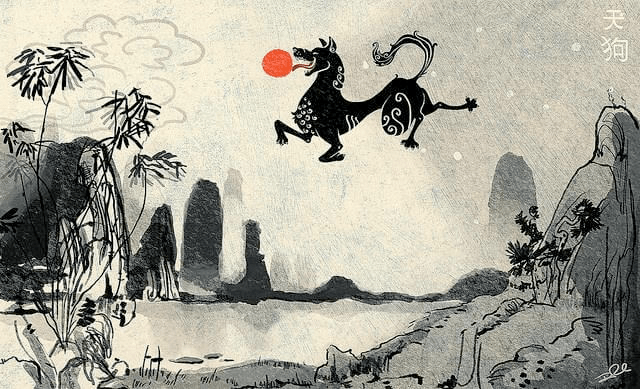
The Sun- eating Dog- Tian Gou. Credit: David DePasquale, https://www.davidadepasquale.com/
Since eclipses were omens of great change, stopping sun-eating dogs was serious business. Royal astronomers at the emperor’s court were charged with shooting arrows, banging pots or even used firecrackers and making whatever noise they could to get rid of such eclipsing canines…
Despite their efforts, the tale of the heavenly dog has persisted. 20th century Chinese poet Guo Moruo wrote on Tian Gou:
I am a heavenly dog!
I eat up the Moon,
I eat up the Sun.
I eat up all the planets, I eat up the universe.
I become what I am!
Originally seen as an animal that can counter evil, Tian Gou became synonym to comets seen as bad omens in ancient China…
We hope that you have enjoyed our selection of eclipse paintings/depictions and corresponding descriptions… Feel welcome to share your favorite ones with friends and family!
References
1. Medieval manuscripts blog – https://blogs.bl.uk/digitisedmanuscripts/2017/08/total-eclipse-of-the-sun.html
2. Smithsonian Magazine, The Long History of Art Inspired by Solar Eclipses – https://www.smithsonianmag.com/arts-culture/long-history-of-art-inspired-by-solar-eclipses-180984072/
3. The Atlantic, https://www.theatlantic.com/science/archive/2016/09/an-artists-view-of-an-eclipse/498548/
4. Eclipses Throughout Art History, https://artmejo.com/eclipses-throughout-art-history/
5. China: Solar Eclipses in History and Mythology, https://earthstoriez.com/china-eclipse-history-mythology
6. Live Science, https://www.livescience.com/59890-solar-eclipses-in-fine-art-images.html
7. Art by Cedar Lee, https://www.artbycedar.com/2-new-paintings-of-solar-eclipses/
8. Transient Effects, https://artmuseum.princeton.edu/transient-effects/painter-sun/eclipse-paintings-howard-russell-butler/butlers-eclipse-paintings
9. Depiction of A Solar Eclipse from 1143 BCE in the Pharaonic
Tomb KV9 near Thebes, https://www.arcjournals.org/pdfs/ijhcs/v7-i2/2.pdf
 Eclipses in History
