Muhammad’s Eclipse, 632 CE
See Visibility Map: http://eclipse.gsfc.nasa.gov/5MCSEmap/0601-0700/632-01-27.gif
In ancient times, births and deaths of leaders were correlated to celestial omens. However, Islamic theology did not believe that God sent an eclipse as an omen of its prophet’s birth, Muhammad. Some eclipses have been historically associated to him, though.
Muhammad was born in Mecca in the Year of the Elephant, CE 569-570. His birth year got its name from an invasion by the Abyssinians, who used elephants in the assault. The Year of the Elephant was also memorable because of its solar eclipse.
Afterwards, when Muhammad’s infant son Ibrahim died tragically on January 22, 632 CE, the Sun was eclipsed. Some Meccans said it was a sign from God, but Muhammad said:
“The Sun and Moon are signs of God and do not eclipse for the death or birth of any man.”
Another solar eclipse related to Muhammad occurred 39 years after his death. In 661 CE, Mu’awiyah became leader of the empire after a revolt against Ali, the son of Muhammad’s chief Meccan enemy. Mu’awiyah decided to transfer the prophet’s pulpit from Medina to his capital in Damascus, Syria.
As his men were removing it, stars became visible in a dark sky. It was considered a sign of divine anger and the relic remained in Medina as a symbol of Mu’awiyah’s failure.
Solar Eclipse of the Emperor Louis, 840 CE
See Visibility Map: http://eclipse.gsfc.nasa.gov/5MCSEmap/0801-0900/840-05-05.gif
This is the story of the Eclipse that influenced the division of Europe as we know it today. Louis of Bavaria, the son of Charlemagne, was head of a great empire when, on May 5, 840 CE, he witnessed a solar eclipse.

Fig. 1 – The Treaty of Verdun. Source: Northvegr Foundation, https://www.northvegr.org/
His imagination worked hard against him. Indeed, he
interpreted the phenomenon as a finger pointed at him. He took fright and never recovered, believing that his days must be numbered. Sure enough, he died a month later.
“In the third year of the Indiction, the Sun was hidden from this world and stars appeared in the sky as if it were midnight, on the third day before the Nones of May (May 5) during the Litanies of Our Lord.”
After this, his three sons began to dispute his succession. Their quarrel was settled three years later with the Treaty of Verdun, dividing Europe into three large areas, namely France, Germany and Italy.
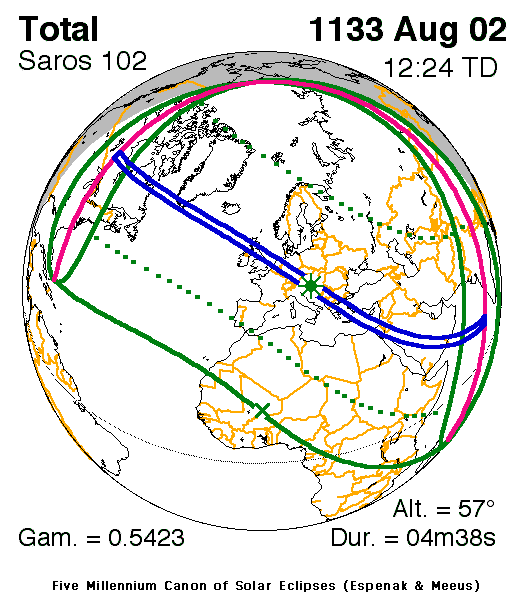
King Henry’s Eclipse, 1133 CE
See Visibility Map: http://eclipse.gsfc.nasa.gov/5MCSEmap/1101-1200/1133-08-02.gif
Visible in England and Germany, this total solar eclipse occurred on August 2, 1133 CE, and prompted many descriptions in the chronicles of both countries.
For the English, the eclipse took place on the day after the departure of King Henry I, being interpreted as an omen of his death. In fact, he died shortly afterwards in Normandy, subsequently confirming the superstition. As for the Germans, they associated the darkening of the Sun to the sack of the city of Augsburg and the massacre of its inhabitants by Duke Frederick.

Fig. 2 – King Henry I. Credit: Public domain.
The Anglo-Saxon Chronicle mentions in 1135 CE:
“In this year King Henry went over sea at Sammas, and the second day as he lay and slept on the ship the day darkened over all lands; and the sun became as it were a three-night-old moon, and the stars about it at midday. Men were greatly stricken and affrighted, and said that a great thing should come hereafter. So it did, for the same year the king died on the following day after Saint Andrew’s mass day, December 2, in Normandy.”
Actually, the eclipse occurred two years before the King’s death, just after his final departure for France.
A Witch’s Eclipse, 1349 CE
Eclipses have also been used through the centuries to trick ordinary people who ignored the science behind the phenomenon. This was the case of a lunar eclipse occurring on June 30, 1349 CE, visible in London. A “smart” witch tried to use that to threaten people to provide her with what she asked for. According to Archdeacon Churton,
“The worthy Archbishop Bradwardine, who flourished in the reign of the Norman Edwards, and died A.D. 1349, tells a story of a witch who was attempting to impose on the simple people of the time. It was a fine summer’s night, and the Moon was suddenly eclipsed. ‘Make me good amends,’ said she, ‘for old wrongs, or I will bid the Sun also to withdraw his light from you.’ Bradwardine, who had studied with Arabian astronomers, was more than a match for this simple trick, without calling in the aid of the Saxon law. ‘Tell me’, he said, ‘at what time you will do this, and we will believe you; or if you will not tell me I will tell you when the Sun or the Moon will next be darkened, in what part of their orb the darkness will begin, how far it will spread, and how long it will continue’.”
Evil plans like that sometimes just do not work, and the presence of Bradwardine should have made that lady just unhappy.
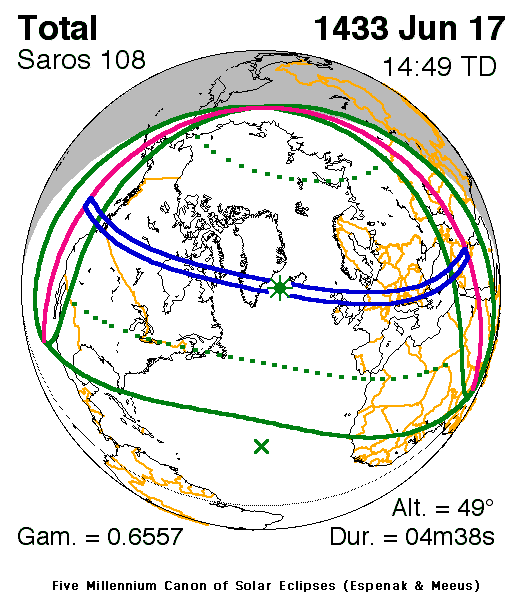
The Black Hour, 1433 CE
See Visibility Map: http://eclipse.gsfc.nasa.gov/5MCSEmap/1401-1500/1433-06-17.gif
One of the most celebrated eclipses of the Middle Ages was called the “Black Hour.” It happened in Scotland and it has been said that darkness came about 3 pm on June 17, 1433 CE, and was very deep.
The eclipse is said to have been unusually extensive, lasting around one hour. The scientific explanation relates to a specific angle between the Sun and Moon that day: at the time of the eclipse, the Sun was only two degrees from perigee and the Moon no more than thirteen degrees from apogee.
Some other interesting facts about this eclipse is that records of the epoch relate that nothing was visible during the height of totality – although it sounds exaggerated – and in the context of a very superstitious time, the pestilence that then prevailed has been attributed to the eclipse.
Fall of Constantinople Eclipse, 1453 CE
The Roman Emperor Constantine, in 324 CE, moved the capital of his realm to ancient Byzantium, which he renamed Constantinople. This capital has ruled the eastern Mediterranean and the Black Sea region for more than a thousand years, providing a strong government and the continuation of the Roman Empire after it collapsed elsewhere.
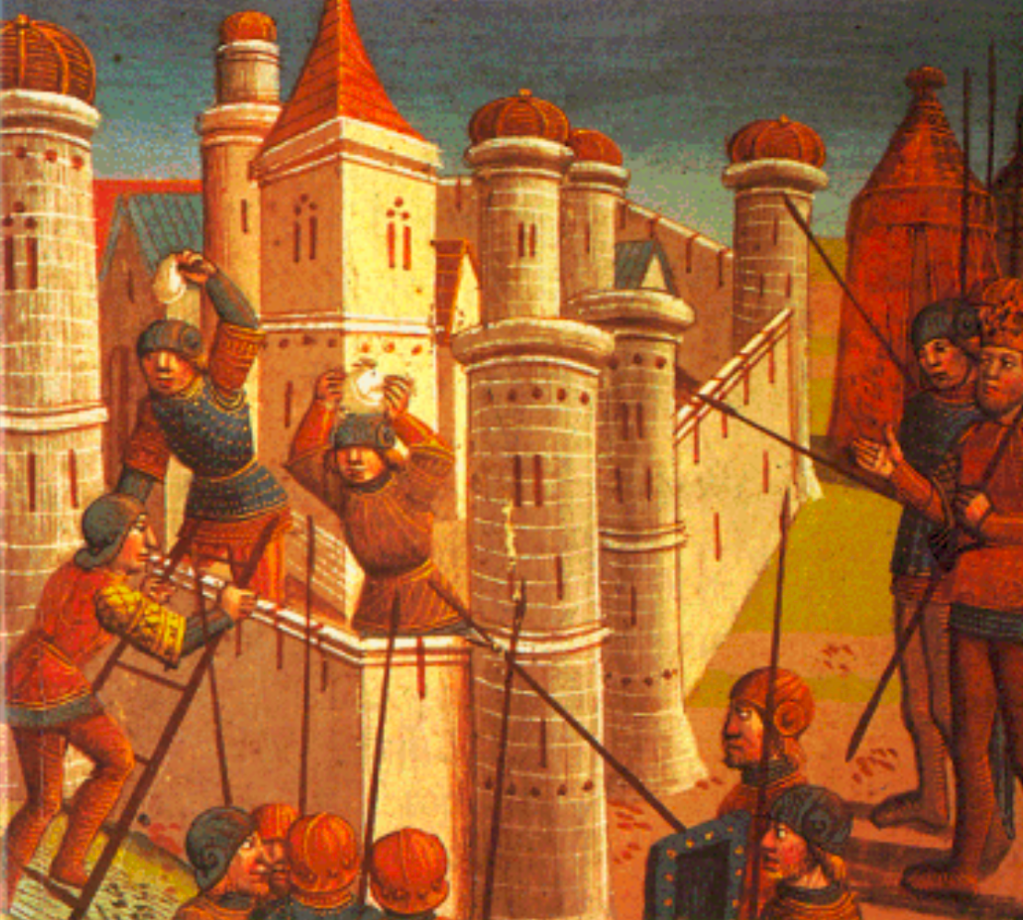
Fig. 3 – The Siege of Constantinople. Scene from the battle of defense of Constantinople, painted in 1499, in Paris. Credit: Public domain.
By the 15th century, the Ottoman Empire, in a large expansion, set out to conquer Constantinople. The Turks laid siege to it in 1402 and 1422, without success, the city being surrounded by its famous impenetrable walls. In 1453, the troops of Sultan Mohammed II returned to the walls.
In addition to 250,000 men, the Turks brought a new eight-meter long cannon, capable of firing 600-kg cannonballs.
Despite everything, the city’s defenders, scarcely 7,000 men in number, repelled three assaults and repaired their damaged walls each night. They were confident in old predictions, according to which Constantinople would never fall. The full Moon rose in eclipse on May 22 and their morale collapsed. Six days later, Mohammed II tried a new assault and succeeded, routing the defenders.
A postern gate had been accidentally left open and some Turks entered the city. As the Sultan’s men crossed the walls, the fight turned into a tumult and Constantinople’s defense collapsed. The terrible sack of Constantinople that followed lasted three days and was a major shock to western civilization. The eclipse had been seen as a bad omen by the Constantinople side and influenced their losing the battle.
 Eclipses in History