“To the best of our knowledge, our Sun is the only star proven to grow vegetables.”
– Philip Scherrer
Other than Earth itself, the Sun and Moon are the celestial bodies most closely related to human reality. Although people in ancient times were curious about the stars and the universe as a whole, the Sun and the Moon have been the main actors in our celestial theater. Since they are most directly associated with quotidian issues such as the day and night cycle, as well as the seasons, they influence vital human economic activities such as agriculture.
The Sun is crucial to us all. It is by far the closest star to the Earth and our ultimate source of warmth, light and energy. Could you imagine life on Earth without the Sun?
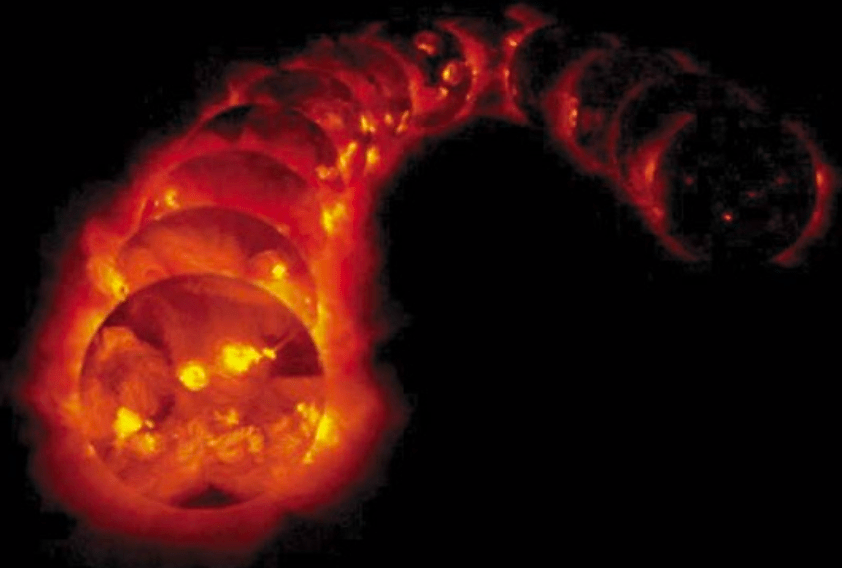
The Changing Sun. These 13 x-ray images, obtained by the Yohkoh spacecraft between 1991 and 1995, provide a dramatic view of the Sun, highlighting how the solar corona changes during the waning part of the solar cycle as the Sun goes from an “active” state (left) to a more passive state (right). Source: NASA.
Early civilizations depended deeply on the Sun. That time, the Sun was essential to estimate the time of day. For this purpose, the Chaldean astronomers developed the gnomon (a shaft erected perpendicular to the horizon), used to indicate the passing hours through its shadow projected on the ground. Ancient people also studied the Sun’s cycles in order to know when to plant crops, to get ready for winter, as well as to plan ceremonies related to the changing seasons. Can you figure out when seasons are about to change?
People in early times were usually fearful of eclipses of the Sun and Moon. Indeed, humans are sometimes frightened by the unknown and by whatever they cannot understand or predict. Imagine a spaceship landing in your backyard with creatures from another world – this would be most frightening! If we had no prior knowledge about the Sun’s disappearance in broad daylight during a solar eclipse (resulting from the temporary passage of the Moon between the Earth and our star), we would fear that the Sun’s light has been truly lost, and that such darkness might last forever.
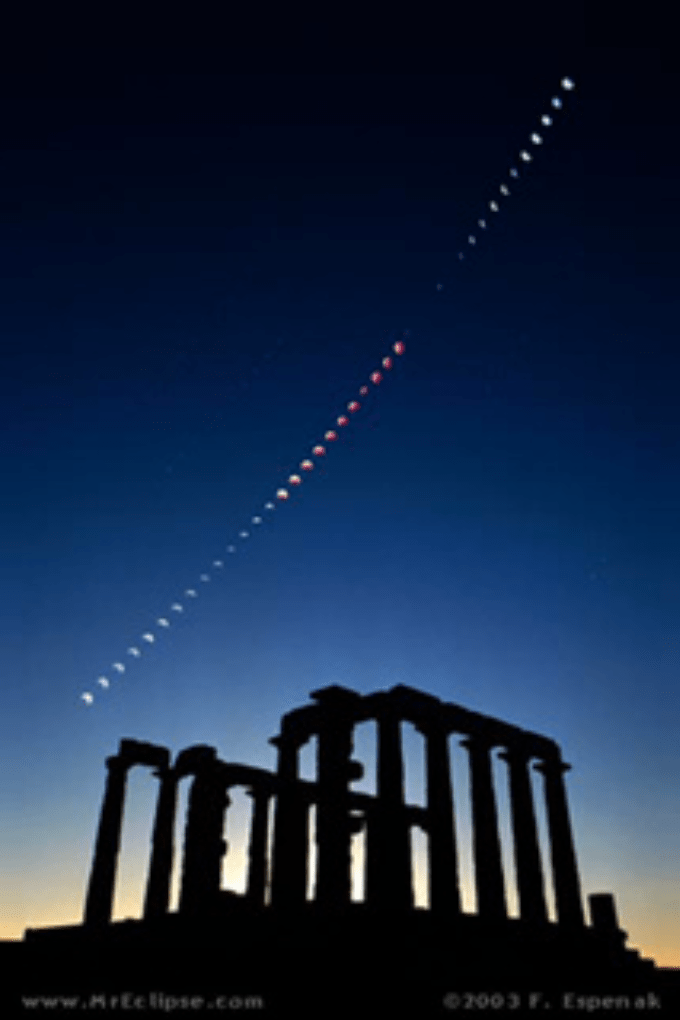
Lunar eclipse in Athens, Greece, January 9, 2001. Multiple exposure technique shows an eclipsed Moon, which during totality assumes a deep red color. Credit: © 2002, photo by Fred Espenak.
Eclipses are ineffable astronomical phenomena that have provoked human curiosity, fear, passion, and other strong feelings throughout the course of history. In this paper, you will learn more about solar and lunar eclipses, along with their influence in early and current societies.
Before discussing further on eclipses, let us better understand the subjective and objective meanings of the Sun in early epochs. Ancient civilizations feared so much the disappearance of the Sun, in special because it ruled their economy. Indeed, those agricultural societies needed sunlight and warmth in order to exist. Moreover, it must have been most intriguing for early civilizations to suddenly be deprived of the Sun’s bright light during the day. They might have asked, “Is this the end of the world?” “Are the Gods angry with our behavior?”
Human imagination is very creative at filling in gaps of understanding.
Although the Sun was regarded as a powerful god and a cosmic hero, it also had enemies to fight. Sometimes demons of darkness obscured the Sun, and people wondered if their god would not return any longer. Likewise, when a lunar eclipse occurs, the way the full Moon is occulted in a vast area of shadow, and the way its color changes to a blood red certainly would indicate some disturbance in the cosmic order. So it would not be a large stretch to wonder whether this was a signal of divine anger, or the action of some demonic power. As a consequence, several myths associated to eclipses arose.
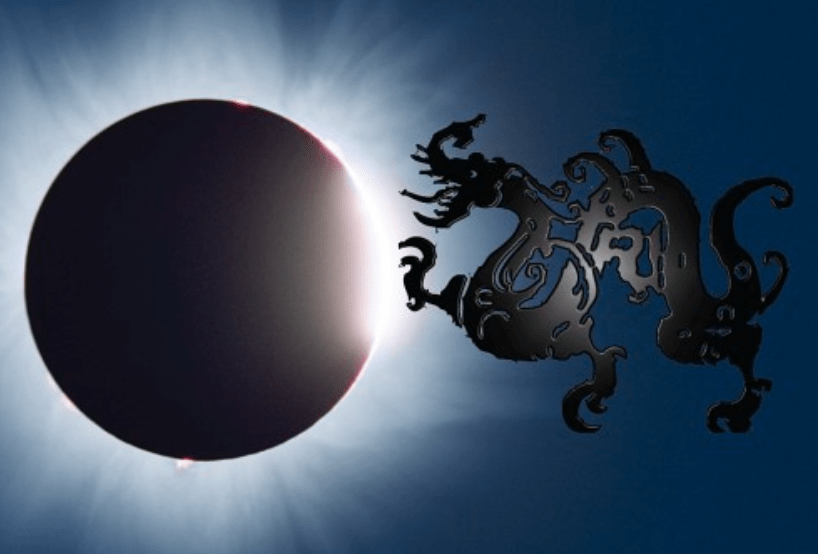
The invisible dragon. People in ancient China and old Southeastern Asian cultures believed that a dragon swallowed the Sun during solar eclipses. Source: NASA.
As mentioned, a solar eclipse occurs when the Moon passes in front of the Sun and obscures it totally or partially. This configuration only exists during the new Moon phase, and then only when the Sun, Moon, and Earth are on a single line, with the Moon in between. Since the Moon’s orbit is tilted 5 degrees to the Earth’s orbital plane, this configuration will not happen every month.
We do not know for certain since how long mankind has witnessed eclipses. Sequences of marks scratched on animal bones dating back 30,000 years suggest the changing phases of the Moon from one cycle to the next.
Though eclipses are well understood today, the apparent disappearance of the Sun and Moon has been attributed to different reasons through the centuries.
The ancient Chinese, for example, thought that there was an invisible dragon in the sky. This dragon was angry with them and, for this reason, would devour the Sun. Whenever this happened, they would follow several rituals intended to scare the dragon away and make the Sun reappear.
One ancient Chinese tradition was to bang drums and pots and make other loud noises during eclipses in order to frighten the dragon away. Even more recently, in the nineteenth century, the Chinese navy fired cannons during a lunar eclipse to scare the dragon that was eating the Moon!
In the ancient Near East, the dragon symbolized the four elements of nature: earth, air, fire, and water. They were usually associated with dark forces, and with the earth-dwelling serpent, representing evil.
The idea of a ferocious animal or beast trying to swallow the heavenly luminaries was common to many civilizations. The battle between the powers of light and the powers of darkness, or the voracious appetite of mythical beasts was the basis for many explanations of eclipses.
On our website, you will learn more about the mechanism of eclipses and discover interesting stories about these awe-inspiring astronomical phenomena that have changed history through the centuries, advanced science and still today fascinate people of all ages, nationalities and cultures worldwide.
 Eclipses in History