The concept of a solar or lunar eclipse being viewed as the gradual eating of the luminary bodies by a celestial invisible dragon is manifested in the earliest Chinese term for eclipse, shih14 (to eat). They believed that eclipses happened when this dragon attempted to devour the Sun or the Moon.
The term eclipse originated from the Greek ekleipsis, from ekleipein ‘fail to appear, be eclipsed,’ from ek ‘out’ + leipein ‘to leave’, also meaning ‘abandon’, ‘failure’.
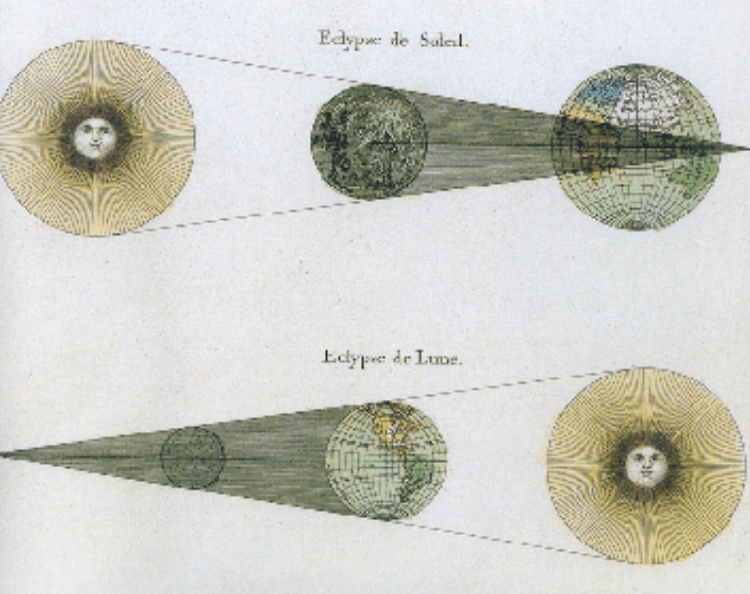
Ancient representation for eclipses of the Sun and Moon. Atlas methodique et elementaire de geographie, by Claude Buy de Mornas. Source: Bibliothèque nationale de France (BnF).
According to the Oxford English Dictionary (1969), eclipse as a noun means “an interception or obscuration of the light of the Sun, Moon or other luminous body, by the intervention of some other body, either between it and the eye, or between the luminous body and that illuminated by it; as of the Moon, by passing through the Earth’s shadow; of the Sun, by the Moon coming between it and the observer; or of a satellite, by entering the shadow of its primary.”
In the figurative, eclipse would mean an “obscuration, obscurity, dimness; loss of brilliance or splendour” e.g., the eclipse of an empire.
 Eclipses in History