Hi and Ho, the Drunk Astronomers, 2137 BCE
Ancient Chinese astronomy was primarily a governmental activity. It was the astronomer’s role to keep track of solar, lunar and planetary motions, and explain what they meant to the ruling emperor.
Throughout the centuries, Chinese astronomers devoted substantial attention towards predicting eclipses. Nevertheless, like all similar efforts prior to the Renaissance, this could only be empirical.
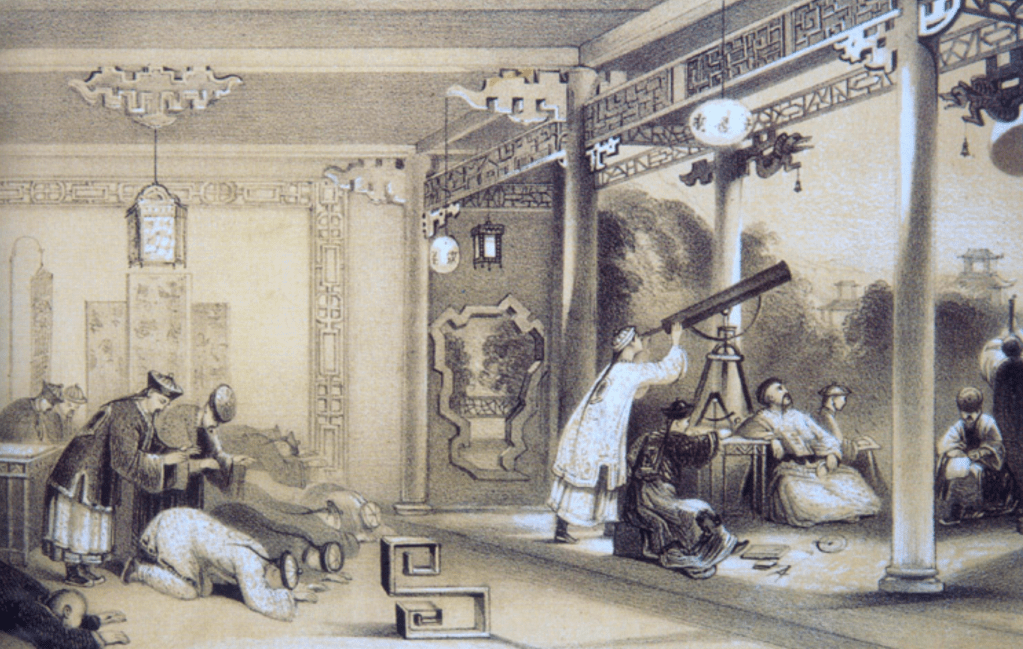
Fig. 1 – Eclipse observation in China around 1840. Astronomers calmly observe an eclipse and the servants, terrified, prostrate themselves on the ground to placate the bad omen. Credit: History of China and India © Mary Evans/ Explorer. Source: Brunier and Luminet, Glorious Eclipses, Cambridge University Press.
The earliest record of a solar eclipse comes from ancient Chinese history. Identifications of this
event have varied from 2165 – 1948 22, 2137 BCE.
According to legend, the Chinese royal astronomers Ho and Hi dedicated too much time to consuming alcohol and failed to predict the forthcoming eclipse. Traditionally, this solar eclipse was recorded in the Shu Ching (Historical Classic), and regarded as from the 3rd millennium BCE.
The earliest record of a solar eclipse comes from ancient Chinese history. Identifications of this
event have varied from 2165 – 1948 22, 2137 BCE.
According to legend, the Chinese royal astronomers Ho and Hi dedicated too much time to consuming alcohol and failed to predict the forthcoming eclipse. Traditionally, this solar eclipse was recorded in the Shu Ching (Historical Classic), and regarded as from the 3rd millennium BCE.
“On the first day of the month, in the last month of autumn, the Sun and the Moon did not meet (harmoniously) in Fang”… so runs the text.
The emperor became very unhappy because, without knowing that there was an eclipse approaching, he could not organize teams to beat drums and shoot arrows in the air to frighten away the invisible dragon. The Sun did survive, but the two astronomers did not have the same luck, and lost their heads for such negligence. This verse, whose author is unknown, well illustrates such tragedy:
“Here lie the bodies of Ho and Hi/ Whose fate though sad was visible/ Being hanged because they could not spy/ Th’eclipse which was invisible.”
Since then, a legend arose that no one has ever seen an astronomer drunk during an eclipse.
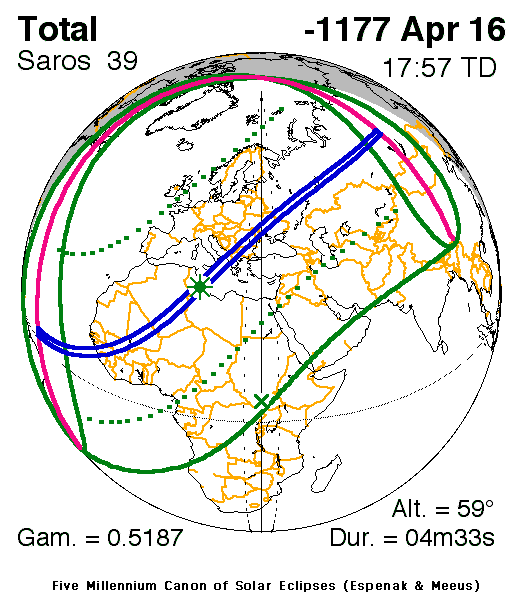
Homecoming of Odysseus, 1178 BCE
See Visibility Map: http://eclipse.gsfc.nasa.gov/5MCSEmap/-1199–1100/-1177-04-16.gif
“. . . and the Sun has perished out of heaven, and an evil mist hovers over all.” – Homer, the Odyssey
The king of Ithaca Island, Odysseus, has been persuaded to go to the Trojan War, which lasted ten years. When Troy fell, the Greeks went back home. However, Odysseus’s enemy, the god of the sea Poseidon became angry with him, making that difficult for him to return home.
Odysseus is the hero from Homer’s Odyssey, and could have returned to his Penelope on day of eclipse. That should have been a very beautiful eclipse, during which all planets were visible simultaneously, and the hidden Sun was “crowned” by the Pleiades.
Basically, we have three evidences to sustain such hypothesis:
a) Plutarch and Heraclitus interpreted a passage in the 20th book of Odyssey to be a poetic description of a total solar eclipse at Odysseus’ return;
b) A century ago, astronomers estimated that such eclipse occurred over the Greek islands on April 16, 1178 BCE, the only one in the region close to the probable date of the fall of Troy;
c) Recently, astronomical references led two scientists to suggest that the eclipse of 1178 BCE possibly coincided with the homecoming of Odysseus.
Almost all classic scholars are skeptical of this correlation. If there was an eclipse, Homer must have had it in mind when he wrote of a seer prophesying the death of Penelope’s waiting suitors and their entrance into Hades. The story actually does not mention an eclipse, but omens and a poetic description of a total solar eclipse.
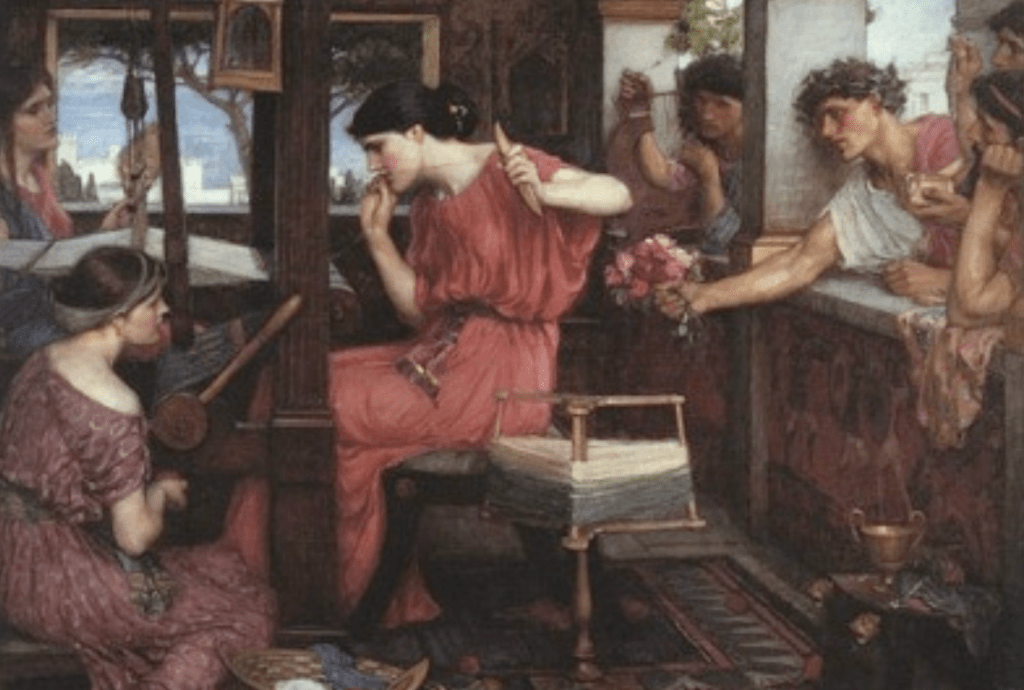
Fig. 2 – Penelope’s suitors, by John William Waterhouse (1912). While Odysseus struggled to return home after the Trojan War, his throne and his wife were being disputed. But Penelope decided to wait for his husband. Credit: Public domain.
The story tells that Odysseus arrived home wearing beggar’s clothes and hiding before revealing himself. It happens that, when Penelope’s suitors sat down at noon for a meal, they started laughing and saw their food spattered with blood. At this moment, the seer Theoclymenus foretells their death: “The Sun has been obliterated from the sky, and an unlucky darkness invades the world.”
This description suggests a solar eclipse over Ithaca. As a matter of fact, Odysseus killed Penelope’s suitors, who were planning to steal his throne and his wife, and spent a long night of love with his wife.
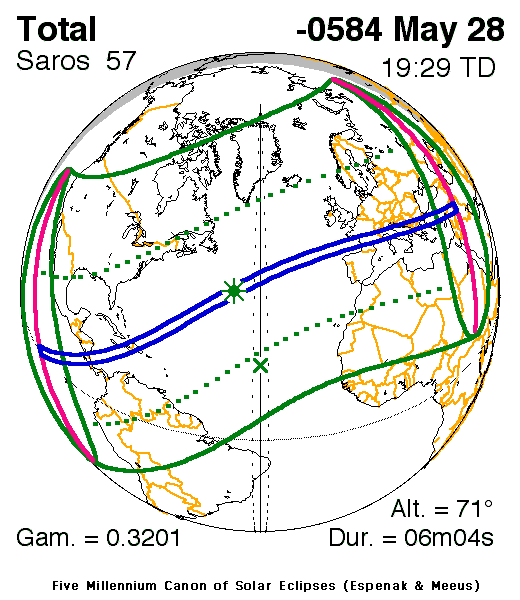
Thales Eclipse, 585 BCE
See Visibility Map: http://eclipse.gsfc.nasa.gov/5MCSEmap/-0599–0500/-584-05-28.gif
Is an eclipse capable of drastically changing the course of history? This story refers to the final battle of a fifteen-year war waged between the Lydians and the Medes. Also known as the “Battle of the Eclipse,” it occurred at the Halys River, Turkey, and was suddenly terminated on May 28, 585 BCE, due to a total solar eclipse, interpreted as an omen indicating that the Gods wanted the fight to stop.
In the West, the first prediction of a solar eclipse is associated with the Greek philosopher Thales of Miletus (624-547 BCE) who, according to Herodotus (490-425 BCE), foretold this eclipse.
“In the sixth year a battle took place in which it happened, when the fight had begun, that suddenly the day became night. And this change of the day Thales the Milesian had foretold to the Ionians laying down as a limit this very year in which the change took place. The Lydians however and the Medes, when they saw that it had become night instead of day, ceased from their fighting and were much more eager both of them that peace should be made between them.”
Although it is argued that Thales used the Babylonian Saros period of 223 lunations, it is today agreed by historians that the Saros period was not discovered before the fifth or fourth century BCE, therefore Thales could not have used that time system.
Considering that the exact dates of eclipses can be calculated, this battle is the earliest historical event for which a precise date is known. Thales was proclaimed a wise man by the oracle of Delphi in 582 BCE, possibly due to this prediction credited to him. However, it is evident that Thales did not understand the scientific basis of the phenomenon.
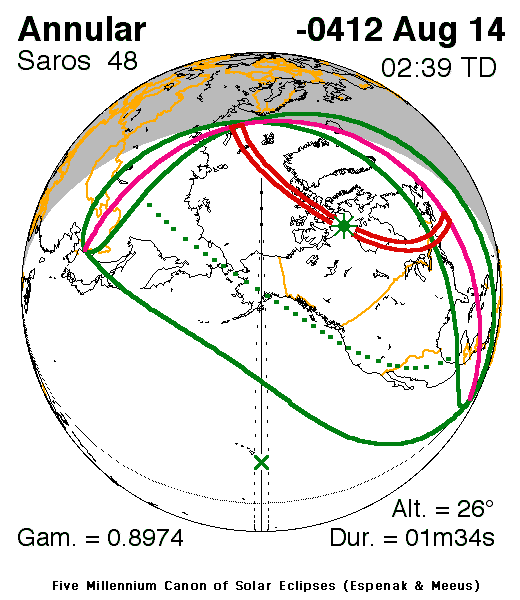
Olympic Games, 413 BCE
See Visibility Map: http://eclipse.gsfc.nasa.gov/5MCSEmap/-0499–0400/-412-08-14.gif
Either success or failure could be sides of the same coin. They usually result of someone’s beliefs, here associated with an eclipse of the Moon, which frightened an entire army who believed that would indicate a bad omen for them. This eclipse occurred on August 14, 413 BCE, during the 91st Olympiad and influenced a battle in the Peloponnesian War.

Fig. 3 – The battle at Arbela, Alexander versus Darius. Credit: Public domain.
Both the Carthaginians and the Greeks had settled parts of the south coast of Sicily, resulting in permanent conflicts. The Athenians were ready to move their forces from Syracuse when the Moon was obscured, bringing disastrous consequences to an Athenian army thanks to the lack of decisive leadership by Nicias, the commander. The Athenian army was confronted in Sicily by the Syracusan army and, having somehow failed, they embarked and left the island. Read this excerpt from by Plutarch, in Life of Nicias:
“Everything accordingly was prepared for embarkation, and the enemy paid no attention to these movements, since they did not expect them. But in the night there happened an eclipse of the Moon, at which Nicias and all the rest were struck with a great panic, either through ignorance or superstition. As for an eclipse of the Sun, which happens at the Conjunction, even the common people had some idea of its being caused by the interposition of the Moon; but they could not easily form a conception, by the interposition of what body the Moon, when at the full, should suddenly lose her light, and assume such a variety of colors. They looked upon it therefore as a strange and supernatural phenomenon, a sign by which the Gods announced some great calamity. And the calamity came to pass, but only indirectly was it caused by the Moon.”
Indeed, soldiers and sailors were very frightened by this celestial omen and were reluctant to leave. Nicias consulted the soothsayers and postponed the departure for twenty-seven days. This delay gave an advantage to the Syracusans, who defeated the entire Athenian fleet and army, killing Nicias.
Eclipse of Alexander, 331 BCE
Eclipses are sometimes interpreted as lucky signals coming from the sky. This was the case with Alexander the Great (356-323 BCE) after conquering Egypt. He marched east and pushed the Persians out of Babylonia, pursuing them north into Assyria.
Just some eleven days before the victory of Alexander over Darius, in Arbela, Assyria, Plutarch and Pliny mention that the Moon had been totally eclipsed. See this excerpt of Plutarch, in Life of Alexander:
“There happened an eclipse of the Moon, about the beginning of the festival of the great mysteries at Athens. The eleventh night after that eclipse, the two armies being in view of each other, Darius kept his men under arms, and took a general review of his troops by torch-light.”
This unexpected occurrence seems to have created considerable tumult in an alarmed Assyrian camp, a fact noticed by Alexander. His friends suggested an attack on the enemy’s camp at night, but Alexander preferred that the Macedonians should have a good night’s rest.
It was then that he uttered the celebrated answer,
“I will not steal a victory.”
The eclipse happened on September 20, 331 BCE, and the celebrated Battle of Arbela, by its turn, was fought on October 1st, 331 BCE.
The Greek knowledge of eclipses was largely derived from the Babylonians after 330 BCE, so probably Alexander obtained that information with the expert Babylonian astronomers.
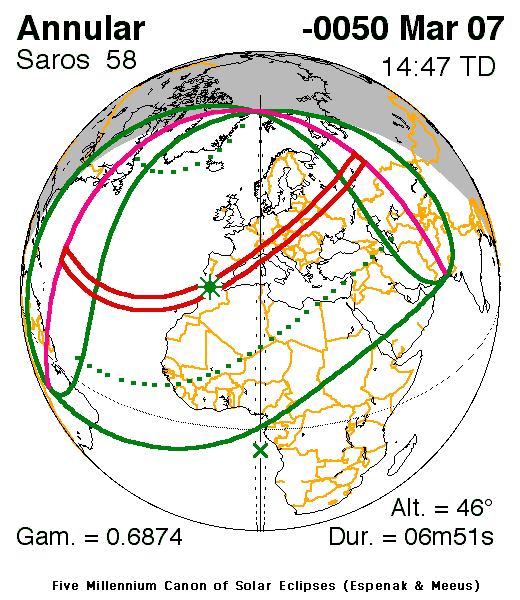
Ceasar Eclipse, 51 BCE
See Visibility Map: http://eclipse.gsfc.nasa.gov/5MCSEmap/-0099-0000/-50-03-07.gif
Julius Caesar (100-44 BCE) died in 44 BCE and Arago associated his death with an annular eclipse of the Sun. Pliny, Plutarch and Tibullus describe that; Seneca and Suetonius add a comet to make the story more impressive. Shakespeare used it for his dramatic purposes. When he was writing, the belief that God intervened in the world to punish individuals or nations for their sins was strong, so it is reflected in his writing, such as in the excerpt below, from Hamlet 1.1:
“In the most high and palmy state of Rome,
A little ere the mightiest Julius fell,
The graves stood tenantless, and the sheeted dead Did squeak and gibber in the Roman streets: As, stars with trains of fire and dews of blood, Disasters in the sun; and the moist star, Upon whose influence Neptune’s empire stands, Was sick almost to doomsday with eclipse.”
Actually, there was no eclipse when Caesar passed away. The factual record is that about the time of the great warrior’s death there was an extraordinary dimness of the Sun. Johnson suggests that Arago should have confused the record of an eclipse with some sort of meteorological interference. Suetonius also implies that the event had a meteorological origin, so that may be regarded as some type of cloud formation.
Nonetheless, we know accurately the day Caesar crossed the Rubicon, seven years before his death, on March 7, 51 BCE, because that was the only possible eclipse corresponding to the one mentioned by Dion Cassius.
Augustus’ Eclipse, 14 CE
Soon after the death of Augustus, Tacitus mentions a lunar eclipse, which has been identified with the eclipse of September 27, 14 CE. Soldiers thought the phenomenon was associated with their adventures, favoring their efforts.
They believed that if they made much noise they could have the eclipse to favor them. Tacitus says:
“The Moon in the midst of a clear sky became suddenly eclipsed; the soldiers who were ignorant of the cause took this for an omen referring to their present adventures: to their labors they compared the eclipse of the planet, and prophesied ‘that if to the distressed goodness should be restored her wonted brightness and splendor, equally successful would be the issue of their struggle.’ Hence they made a loud noise, by ringing upon brazen metal, and by blowing trumpets and cornets; as she appeared brighter or darker they exulted or lamented.”
The Crucifixion Eclipse, 33 CE
See Visibility Map:
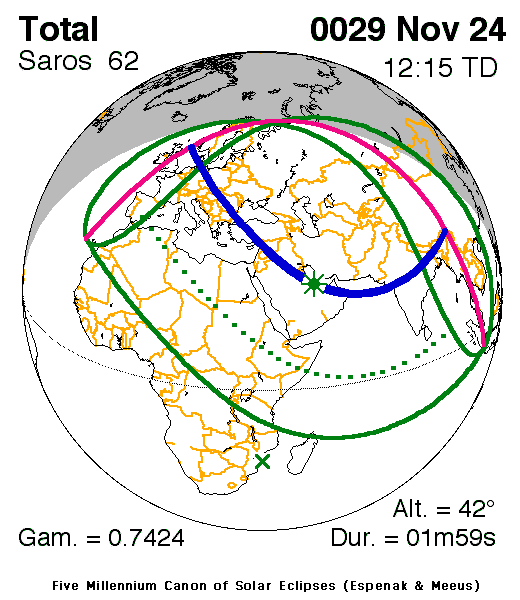
http://eclipse.gsfc.nasa.gov/5MCSEmap/0001-0100/29-11-24.gif
Jesus Christ should have been crucified on day of eclipse, during the period when Pontius Pilate was procurator of Judea (26-36 CE). However, there is no consensus on the date. According to the evangelists, Jesus was crucified on a Friday afternoon, some hours prior to the beginning of the Jewish Sabbath. Evidence suggests April 3, 33 CE, while others suggest April 7, 30 CE.

Fig. 4 – The crucifixion eclipse. According to the evangelists, the Sun darkened during the crucifixion of Christ. Later, the event was associated with an eclipse that was visible at Jerusalem. Credit: © Valenciennes, Musee des Beaux Arts, photo R.G. Ojeda.
Another hypothesis is that of a solar eclipse visible at Jerusalem on November 24, 29 CE. The Greek historian Phlegon mentions this eclipse in his History of the Olympiads, and says that it has been accompanied by an earthquake.
“In the fourth year of the 202nd Olympiad, there was an eclipse of the Sun which was greater than any known before and in the sixth hour of the day it became night; so that stars appeared in the heaven; and a great Earthquake that broke out in Bithynia destroyed the greatest part of Nicaea.” In fact, mention is also made in the Bible to the Sun being darkened earlier that day:
“The Sun shall be turned into darkness.”
However, there are also various allusions in the Bible to the Moon being dark and turned to blood when it rose in the evening after the crucifixion, which sounds like a lunar eclipse. In Acts of the Apostles, Peter also refers to a Moon that is the color of blood and a darkened sky. There is other evidence that on that day the Moon appeared like blood.
“Jesus was delivered to him by Herod, Archelaus, Philip, Annas, Caiphas, and all the people. At his crucifixion the Sun was darkened; the stars appeared and in all the world people lighted lamps from the sixth hour till evening; the Moon appeared like blood.” This may be the result of a dust storm caused by the khamsin, a hot wind coming from the south. Under such circumstances, a lunar eclipse while there is much suspended dust, one would expect the Moon to appear the dark crimson of blood.
The reason why the Moon is blood red is that, although it is geometrically in the Earth’s shadow, sunlight is refracted through the Earth’s upper atmosphere, where normal scattering will prevent blue light from penetrating. But this refracted light would be much weaker than direct light from even a small portion of the Sun and the blood color associated with the eclipse would not be visible to the unaided eye. However, the Moon would have an amber color from atmospheric absorption, similar to any other occasion when the Moon is low in the horizon.
As mentioned, there is controversy among researchers whether that was a solar or a lunar eclipse, and also controversy about the date. In any case, an eclipse occurring in the very same day of the crucifixion would have been interpreted by believers as a supernatural sign and influenced the change of mind of the Jews and Pilate towards the body of Christ, leading to the placing of a military guard on the tomb.
 Eclipses in History